Port Service Requests and Allocations
This update focuses on cutting down manual work and making the day-to-day booking flow smarter on both sides of the desk. Bulk booking now supports uploading itinerary exports directly instead of typing every call by hand, port users get clearer visibility into what's waiting for their attention, and ports gain more flexibility in how they handle requests that fall outside their normal booking window. We've also significantly deepened port services - from real-world shore power modeling to sharing equipment like tugboats across ports.
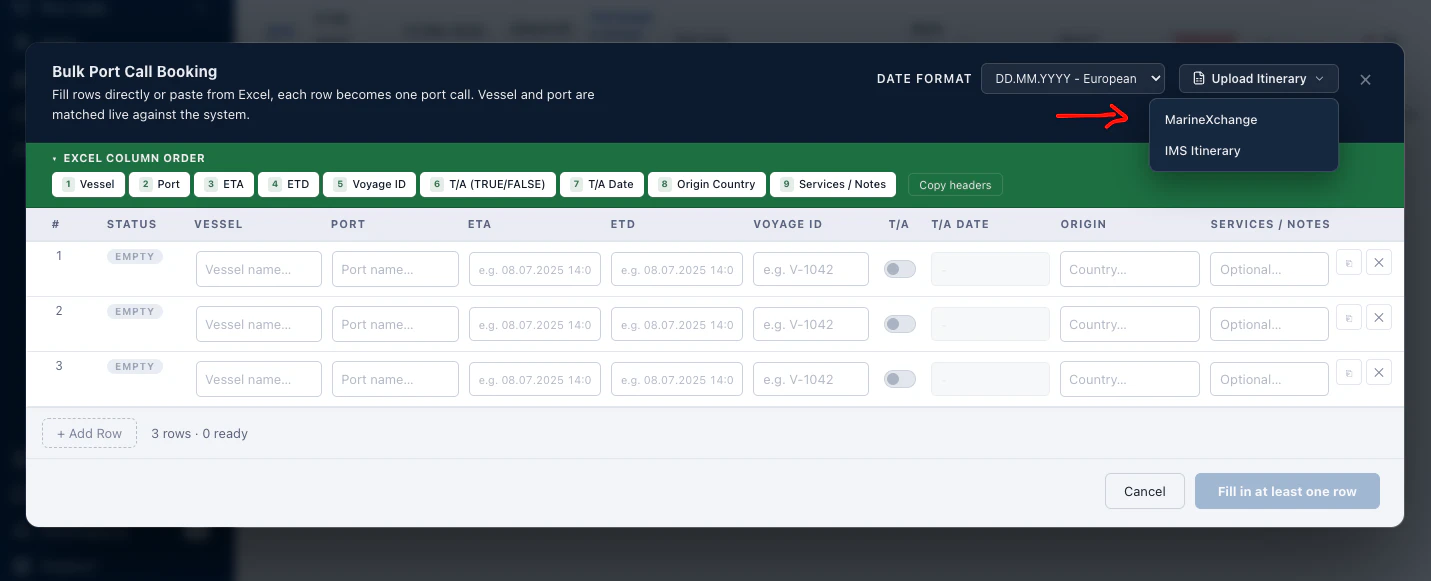
Upload Itinerary
A new dropdown lets you upload an itinerary export directly and skip manual entry entirely, dokk parses the file in your browser and fills the whole grid: vessel, port, arrival/departure, turn-around status, and voyage ID.
- Supports common cruise itinerary export formats, including MarineXchange and IMS.
- We will also include more formats as time goes on, agents can send us itineraries from their respective cruise line that they deal with and we will make sure it can be uploaded directly to the bulk booking system (be aware of duplicates though).
Multi-day port stays are automatically recognized and merged into a single call. Port and vessel names are matched against your system even with accented characters (Húsavík ↔ Husavik) or extra annotations from the source file.
Smarter origin-country handling
For multi-stop voyages, the country of origin now auto-fills from the previous stop in the itinerary, you only need to fill it in for the very first call of a voyage, and we'll gently flag that row so it doesn't get missed.

Live policy checks
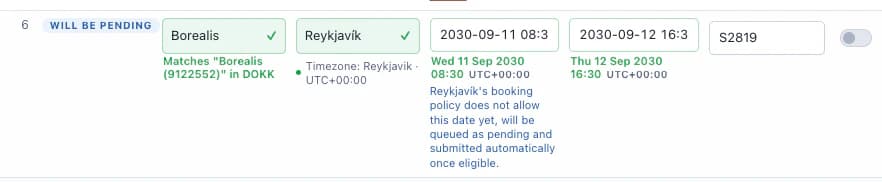
Every row is checked against the port's actual booking-horizon policy, standard and turn-around, as you type or import, with clear standard vs. turn-around guidance shown side by side so there's no ambiguity about why a date is flagged. This applies both to the bulk booking and single booking system in the flyout.
Port Calls page displays priority calls first
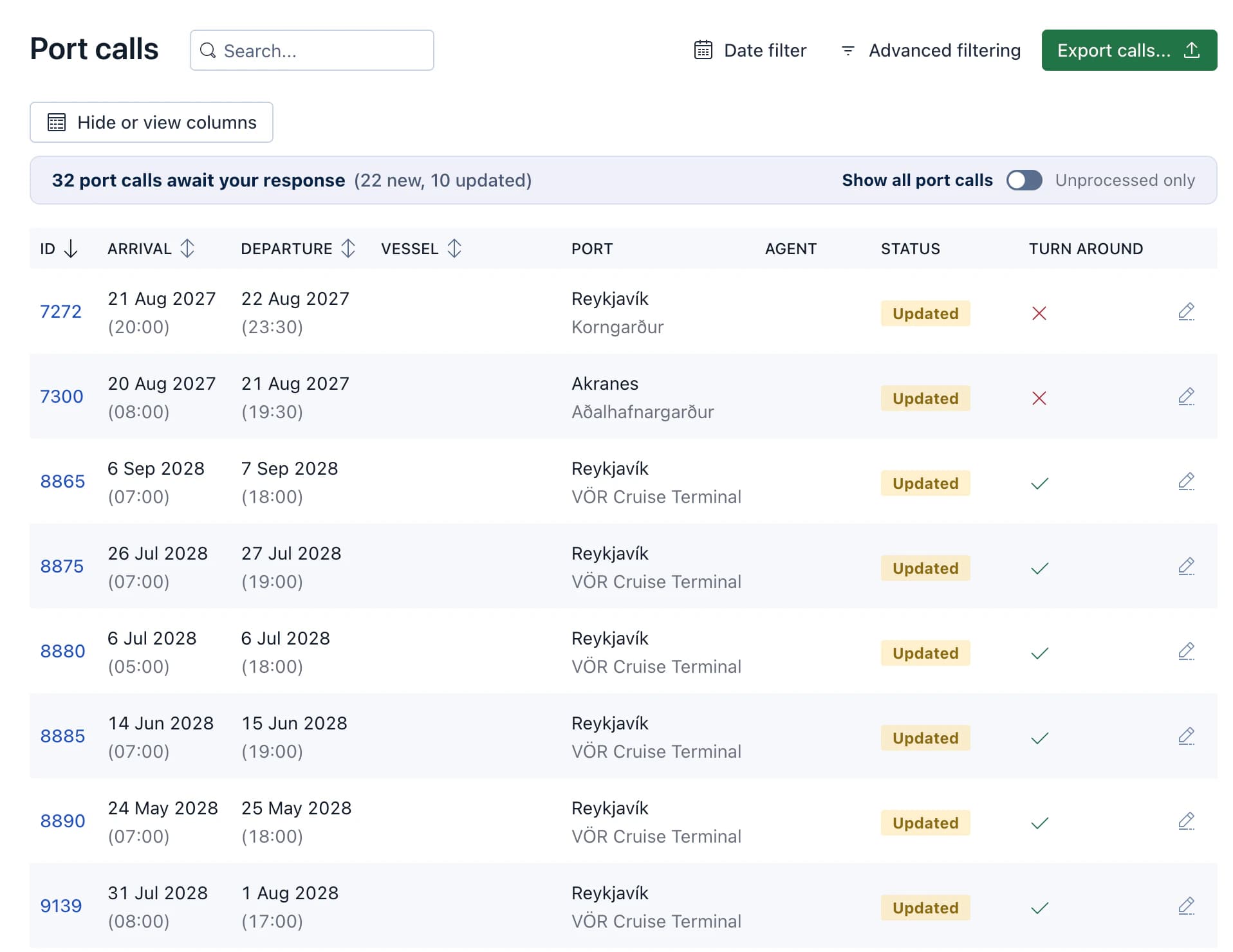
This applies to the “first come, first serve” rule where the oldest requested or updated calls get pushed to the top of the stack for the attention of the port user. A banner has also been placed above which details the calls awaiting the response from the port user to process.
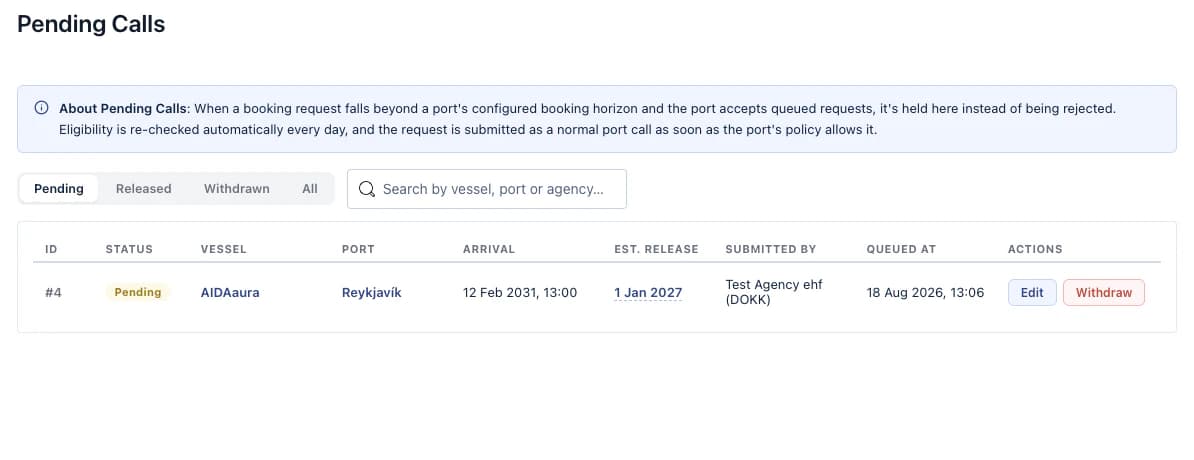
Pending Calls (Booking Horizon Queue)
Ports can now opt in to queue booking requests that fall beyond their booking horizon instead of rejecting them outright. If a port has this turned on, a request beyond the horizon is automatically held as a pending call, no manual resubmission needed. Eligibility is re-checked daily against the port's current policy, and the moment it opens up, the request goes live as a normal port call.
- A new Pending Calls page (in the sidenav, under Port Calls) lists every queued request with its status and an estimated release date.
- Agents can withdraw a pending call or adjust its arrival/departure/turn-around date, the date can only be moved to another date still beyond the port's horizon, so it can't be used to sneak a near-term booking past the normal review process.
- You'll get a notification the moment your queued request is released and submitted.
Duplicate call protection
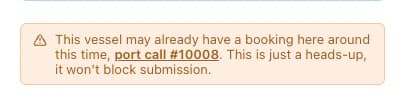
We also added a smart feature to check if an agent is accidentally placing the same port call twice by using the port, vessel and date of the call as parameters for guardrails. If the ship is already booked within a 12 hour window which matches these conditions then the call won’t be applied.
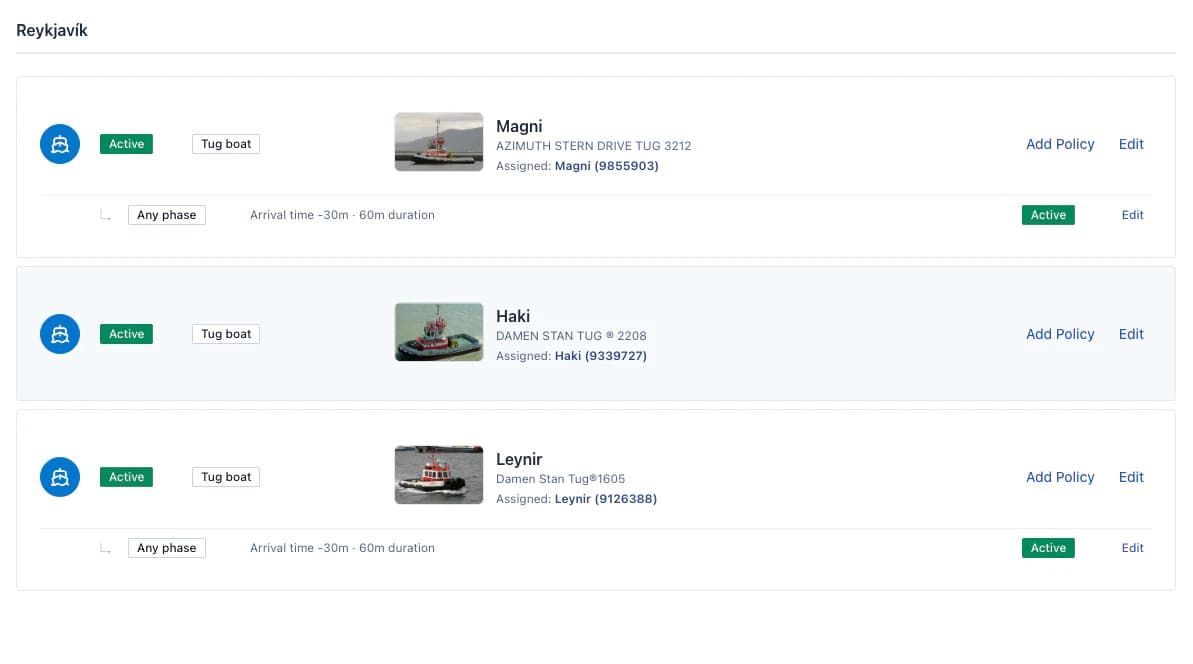
Tug Boat Services now connect to Vessels
If you operate a Tug Boat Service and create the entry for the vessel in DOKK, then you can assign the vessel to any Tug Boat services you offer. This feature is only available to port and tugboat operator organizations which are a new entry to DOKK.
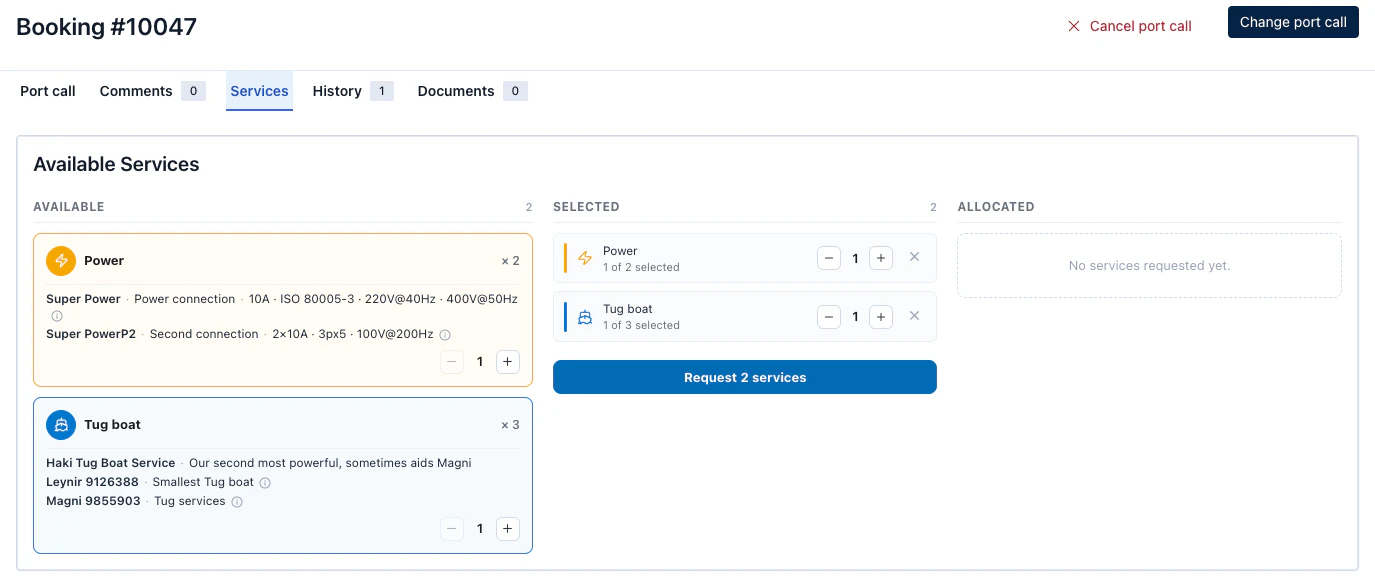
Port Service Requests and Allocations between Ports and Agencies
A few things to note in regards to Port Services with requests from agencies and service allocations from port users.
- Port Services can have images uploaded and attached to them.
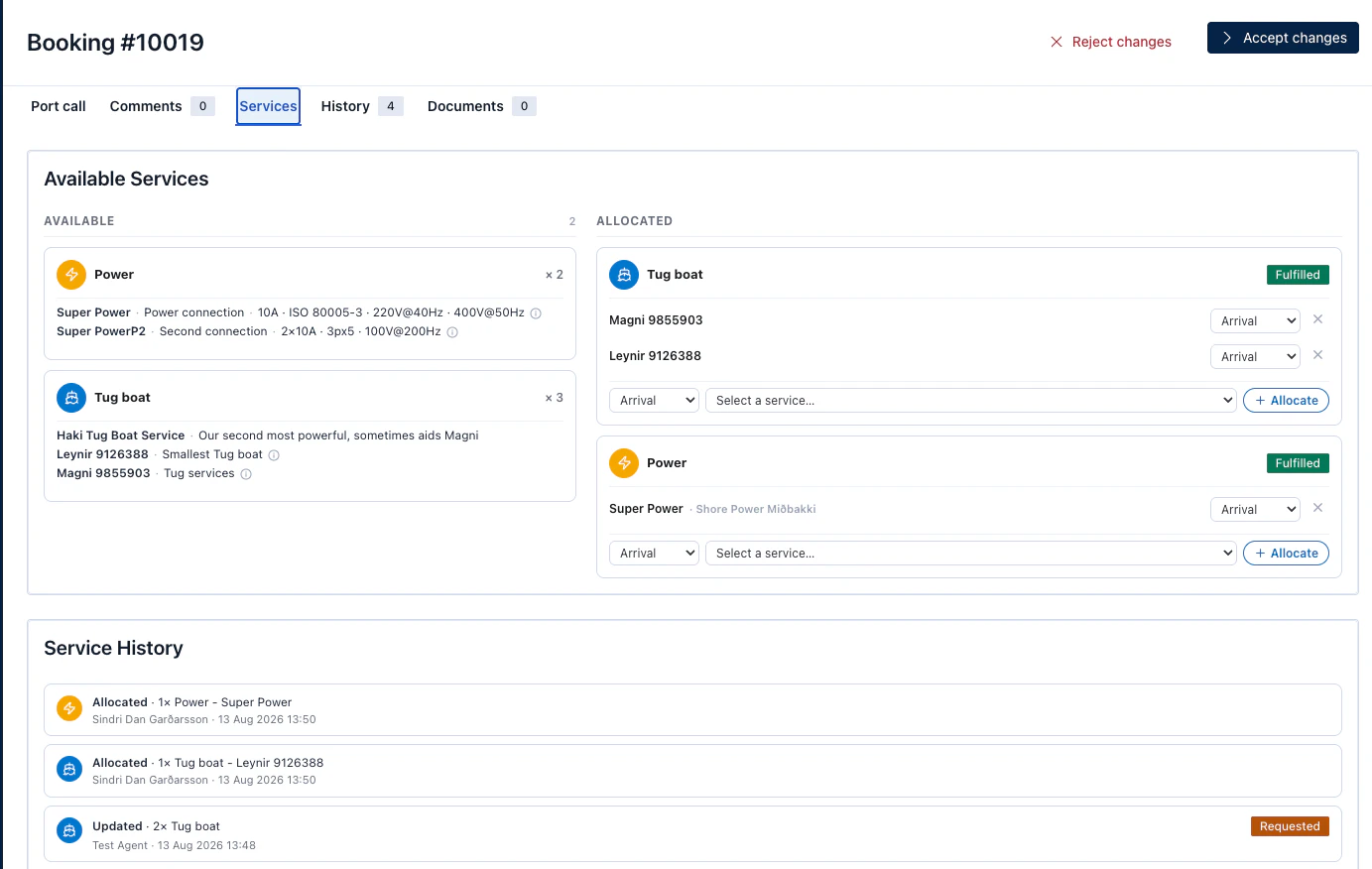
- Agents can request the services a vessel needs for a call - shore power, water, tugboats, waste, and more - directly from the port call itself, and ports allocate the specific resource that fulfills each request.
- Capacity and scheduling conflicts are checked automatically, so a port can offer exactly what it has without double-booking a connector, a tug, or any other limited resource. It's built to scale with how a port actually operates: multiple physical instances of the same service, shared equipment across sister ports, and detailed specs per service so agents know exactly what they're getting.
- The Port Services page has been renamed Service Catalogue for clarity, and gained a dedicated flow for creating and editing connection groups directly from the page.
Unprocessed Service Requests Visibility
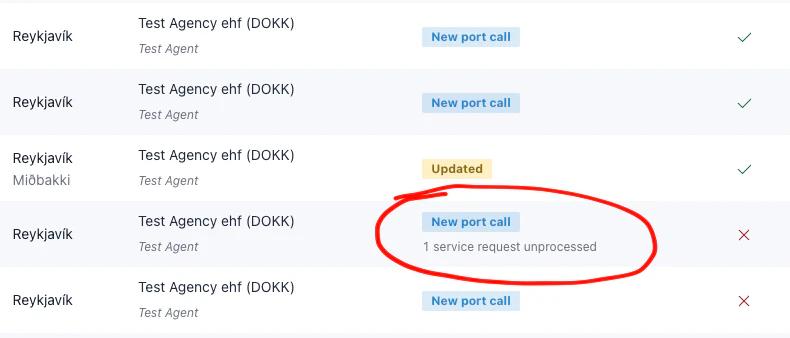
Unprocessed service requests are now surfaced directly on the main Port Calls list. When an agent has placed a service request that nobody's responded to yet, port users see it immediately as a small note under the call's status - no need to open each call individually to check.
Service Allocations Page
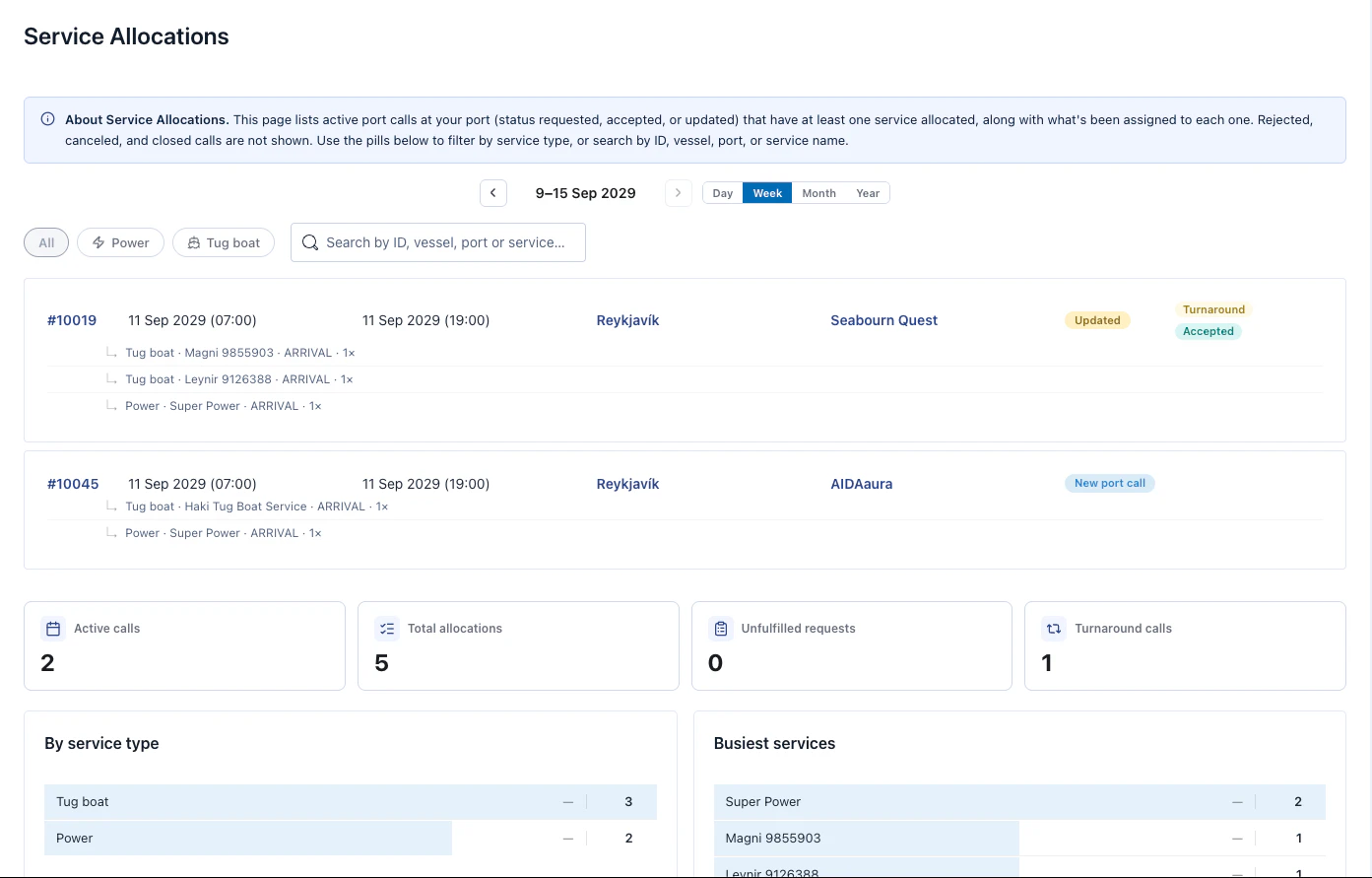
This is a new page which works alongside the service allocations for each port call.
- The Service Allocations page has a day/week/month/year navigator with a "jump to next" shortcut, plus a statistics section showing active calls, total allocations, and busiest services for the selected period - turning it from a flat list into an actual scheduling overview.
Dynamic Port Services
Dynamic services can now be shared between sister ports in the same organization. If you operate more than one port - a tugboat normally based at your main port can occasionally be allocated to a secondary port's calls too, without needing a duplicate service entry.
Booking conflicts are still fully protected: if that tugboat is already committed elsewhere at an overlapping time, the system catches it regardless of which port the call is at.
You can activate this sharing on any active mobile service like Tug Boats.

Shore Power Connections Updated
- Shore power connections now model real-world installations, not just a single generic spec. A shore power service can list multiple simultaneously-available voltage/frequency combinations - because real connection points often support several (e.g. 400V/50Hz and 690V/50Hz on the same plug) - with power capacity that varies per combination, plus plug count, connector standard and cross-compatible connectors, cable management system, and safety interlock details.
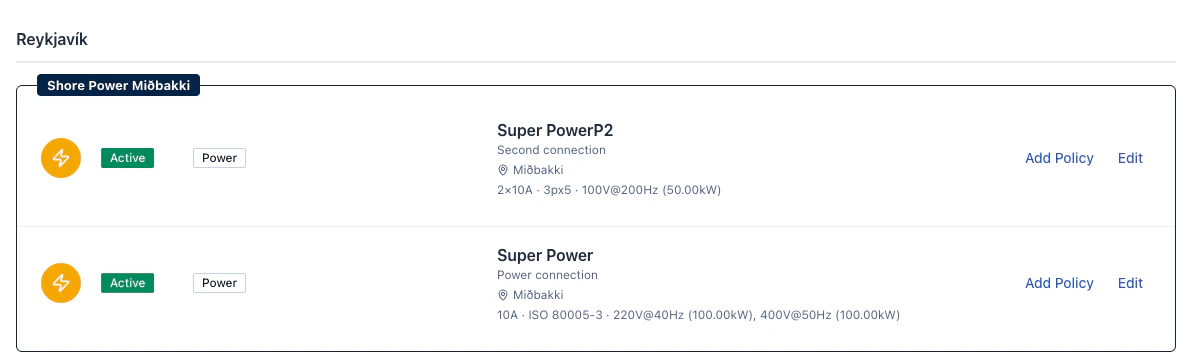
- Piers with multiple physical connection points (e.g. two shore power connectors at the same berth) can now be linked together as a "connection group" - shown as a clearly bordered set in the port's service catalogue, and clustered together when a port user is picking which specific connector to allocate, so it's obvious at a glance they're the same physical installation rather than unrelated duplicate listings.
- Stationary services now display their assigned berth directly on the service card.
- The screenshot is only an example of Shore Power connections and do not reflect real data.
Fixes
- Paste from Excel, properly. Copying a single column out of a spreadsheet and pasting it into any column of the bulk grid now lands exactly where you click - no more values spilling into the wrong fields.
- Fixed a timezone bug where the monthly calendar could show the wrong day-of week for viewers outside Iceland's timezone - dates now line up correctly no matter where you're viewing from.
- Agents can’t update the turnaround settings (except the date time of turnaround if it has already been applied) to any port call that has already been accepted.
- This is to avoid agents circumnavigating the port’s restrictions on bookings that prioritize turnarounds vs standard arrivals.
- Fixed a layout bug where the sidebar could briefly stretch across the entire window the first time the Insights page loaded, before the page's content had finished its initial check.